Angola: No accountability five years after protestor killing

Source: Amnesty International –

On the fifth anniversary of the fatal shooting of Inocêncio de Matos, on his way to participate in a protest, in Luanda, Amnesty International’s Deputy Regional Director for East and Southern Africa Vongai Chikwanda said:

“Five years on, the relatives of Inocêncio de Matos are still awaiting justice. He did not commit any crime or pose a risk to authorities or a third party when he was shot dead. He was killed for simply attempting to exercise his right to freedom of assembly, as defined in the Angolan constitution and other regional and international instruments to which Angola is a state party.

Five years on, the relatives of Inocêncio de Matos are still awaiting justice. He did not commit any crime or pose a risk to authorities or a third party when he was shot dead.

Vongai Chikwanda, Deputy Regional Director, Amnesty International East and Southern Africa Regional Office

“His case is not isolated, it paints a picture of the long running impunity in Angola, where security forces act as if they are above the law.  

Angolan authorities must ensure justice for Inocêncio by immediately revealing publicly the outcome of the investigations into his killing, anyone found culpable must be brought to account in a fair trial.

Vongai Chikwanda

“Angolan authorities must ensure justice for Inocêncio by immediately revealing publicly the outcome of the investigations into his killing, anyone found culpable must be brought to account in a fair trial.”

Background

On 11 November 2020, almost three years after João Lourenço, the president of Angola, had promised holding municipal elections, Inocêncio de Matos and others left their neighborhoods to gather at the Largo 1º de Maio, in Luanda, to protest for the elections. Hours before the protest, security forces blocked the main avenues leading to the Largo 1º de Maio to repress the protest. So far, only the victim’s witnesses have been heard. During attempts to circumvent the blockage, security forces fired live ammunitions and Inocêncio de Matos was fatally shot. The Services for Criminal Investigations (SIC) initiated an investigation into the killing. So far, only the victim’s witnesses have been heard. However, five years later, the outcome of the investigation is yet to be made public.

What is Nuclear Energy? The Science of Nuclear Power

Source: International Atomic Energy Agency (IAEA) –

Nuclear Explained

The IAEA is showcasing nuclear solutions to global energy and environmental challenges at the 30th United Nations Climate Change Conference – COP30. This article explores the science of nuclear power – nuclear energy.

Andrea Galindo, IAEA Office of Public Information and Communication

Nuclear energy is a form of energy released from the nucleus, the core of atoms, made up of protons and neutrons. This source of energy can be produced in two ways: fission – when nuclei of atoms split into several parts – or fusion – when nuclei fuse together.

The nuclear energy harnessed around the world today to produce electricity is through nuclear fission, while technology to generate electricity from fusion is at the R&D phase. This article will explore nuclear fission. To learn more about nuclear fusion, click here.

What is nuclear fission?

Nuclear fission is a reaction where the nucleus of an atom splits into two or more smaller nuclei, while releasing energy.

For instance, when hit by a neutron, the nucleus of an atom of uranium-235 splits into two smaller nuclei, for example a barium nucleus and a krypton nucleus and two or three neutrons. These extra neutrons will hit other surrounding uranium-235 atoms, which will also split and generate additional neutrons in a multiplying effect, thus generating a chain reaction in a fraction of a second.

Each time the reaction occurs, there is a release of energy in the form of heat and radiation. The heat can be converted into electricity in a nuclear power plant, similarly to how heat from fossil fuels such as coal, gas and oil is used to generate electricity.

Nuclear fission (Graphic: A. Vargas/IAEA)

How does a nuclear power plant work?

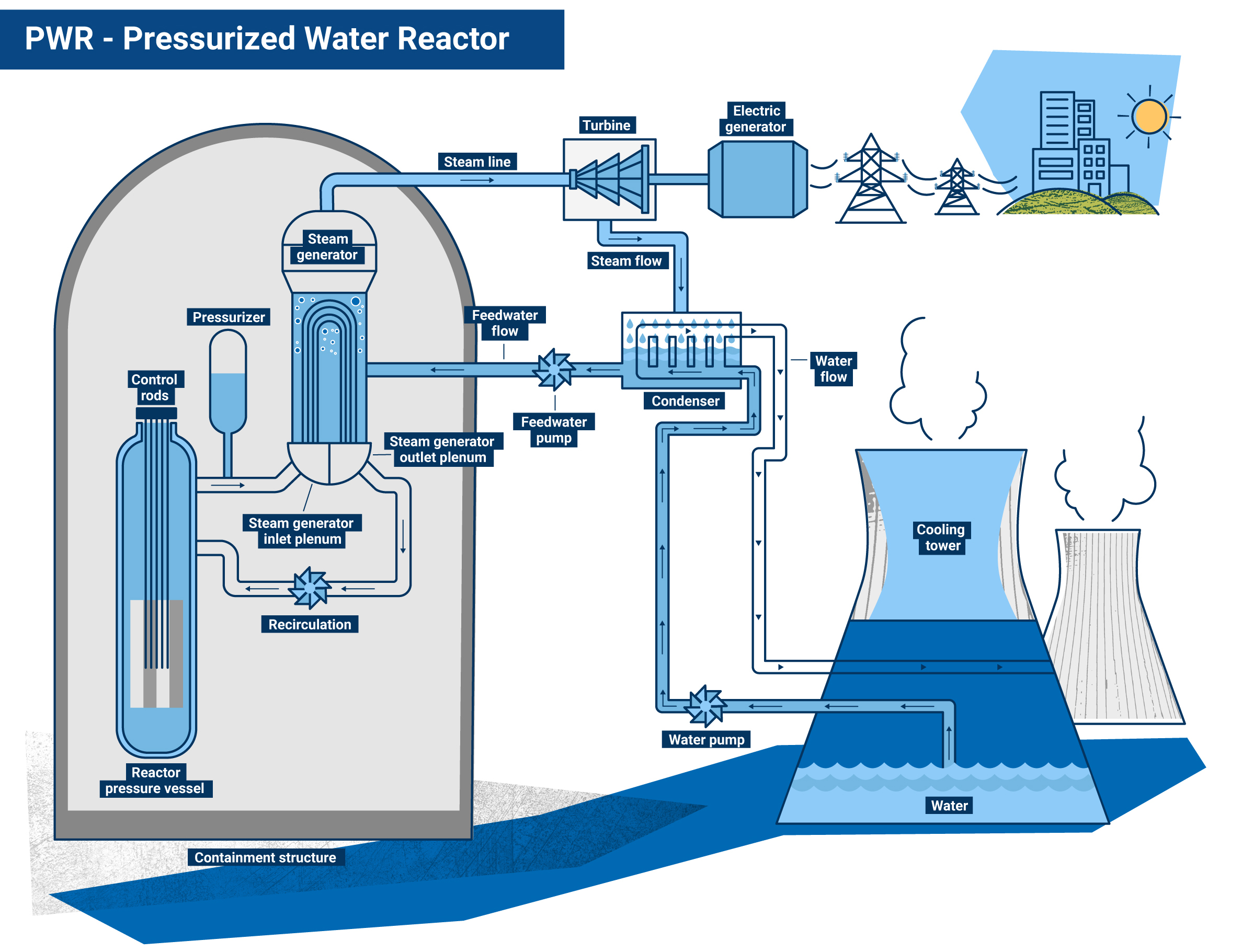
Inside nuclear power plants, nuclear reactors and their equipment contain and control the chain reactions, most commonly fuelled by uranium-235, to produce heat through fission. The heat warms the reactor’s cooling agent, typically water, to produce steam. The steam is then channelled to spin turbines, activating an electric generator to create low-carbon electricity.

Find more details about the different types of nuclear power reactors on this page.

Pressurized water reactors are the most used in the world. (Graphic: A. Vargas/IAEA)

Mining, enrichment and disposal of uranium

Uranium is a metal that can be found in rocks all over the world. Uranium has several naturally occurring isotopes, which are forms of an element differing in mass and physical properties but with the same chemical properties. Uranium has two primordial isotopes: uranium-238 and uranium-235. Uranium-238 makes up the majority of the uranium in the world but cannot produce a fission chain reaction, while uranium-235 can be used to produce energy by fission but constitutes less than 1 per cent of the world’s uranium.

To make natural uranium more likely to undergo fission, it is necessary to increase the amount of uranium-235 in a given sample through a process called uranium enrichment. Once the uranium is enriched, it can be used effectively as nuclear fuel in power plants for three to five years, after which it is still radioactive and has to be disposed of following stringent guidelines to protect people and the environment. Used fuel, also referred to as spent fuel, can also be recycled into other types of fuel for use as new fuel in special nuclear power plants.

What is the Nuclear Fuel Cycle?

The nuclear fuel cycle is an industrial process involving various steps to produce electricity from uranium in nuclear power reactors. The cycle starts with the mining of uranium and ends with the disposal of nuclear waste.

Nuclear waste

The operation of nuclear power plants produces waste with varying levels of radioactivity. These are managed differently depending on their level of radioactivity and purpose. See the animation below to learn more about this topic.

Radioactive Waste Management

Radioactive waste makes up a small portion of all waste. It is the by-product of millions of medical procedures each year, industrial and agricultural applications that use radiation and nuclear reactors that generate about 9% of the world’s electricity. This animation explains how radioactive waste is managed to protect people and the environment from radiation now and in the future.

The next generation of nuclear power plants, also called innovative advanced reactors, will generate much less nuclear waste than today’s reactors. It is expected that they could be under construction by 2030.

Nuclear power and climate change

Nuclear power is a low-carbon source of energy, because unlike coal, oil or gas power plants, nuclear power plants practically do not produce CO2 during their operation. Nuclear power reactors generate about one quarter of the world’s low-carbon electricity and are crucial in meeting climate change goals.

To find out more about nuclear power and the clean energy transition, read this edition of the IAEA Bulletin.

What is the role of the IAEA?

  • The IAEA establishes and promotes international standards and guidance for the safe and secure use of nuclear energy to protect people and the environment.
  • The IAEA supports existing and new nuclear programmes around the world by providing technical support and knowledge management. Through the Milestones Approach, the IAEA provides technical expertise and guidance to countries that want to develop a nuclear power programme as well as to those who are decommissioning theirs.
  • Through its safeguards and verification activities, the IAEA oversees that nuclear material and technologies are not diverted from peaceful use.
  • Review missions and advisory services led by the IAEA provide guidance on the activities necessary during the lifetime of production of nuclear energy: from the mining of uranium to the construction, maintenance and decommissioning of nuclear power plants and the management of nuclear waste.
  • The IAEA administers a reserve of low enriched uranium (LEU) in Kazakhstan, which can be used as a last resort by countries that are in urgent need of LEU for peaceful purposes.

This article was first published on iaea.org on 2 August 2021.

Related resources

Russia: Street musicians repeatedly jailed for anti-war songs

Source: Amnesty International –

‘Their only ‘crime’ is singing songs that challenge the suffocating official narrative’ – Denis Krivosheev

Band Stoptime went viral last month signing songs by exiled musicians in St Petersburg

“Carousel arrests” – a practice used to prolong deprivation of liberty without filing criminal charges used to silence musicians

In response to the third time that Diana Loginova (aka Naoko) and Aleksandr Orlov, street music performers from the band Stoptime, are being held in administrative detention, Denis Krivosheev, Amnesty International’s Deputy Director for Eastern Europe and Central Asia, said:

“The repeated arrests of Naoko and her bandmates are punishment for their public performance which have become a breath of fresh air in a country gasping under repression and self-censorship.

“Worse still, the authorities’ persistence in pursuing Naoko and her fellow musicians raises fears that they might be preparing criminal charges against them. Russian lawmakers have introduced so many repressive and vague laws that prosecuting someone for expressing anti-war views is little more than a technicality.

“Authorities must immediately and unconditionally release Naoko and Aleksandr Orlov and other street musicians detained for acts of anti-war protest, simply exercising their right to freedom of expression. Their only ‘crime’ is singing songs that challenge the suffocating official narrative.”

Escalating repression of anti-war performers in Russia

In October, videos of the street band Stoptime performing songs by exiled Russian musicians in Saint Petersburg went viral. Crowds joined in singing lyrics critical of the authorities, human rights violations and the war against Ukraine.

Police arrested the three band members; vocalist Diana Loginova (Naoko), guitarist Aleksandr Orlov and drummer Vladislav Leontyev, on 15 October, accusing them of “organising a mass gathering that violated public order” (Article 20.2.2(1) of the Russian Code of Administrative Offences). Loginova and Leontyev were placed in so-called administrative detention for 13 days, and Orlov for 12 days. The court also fined Loginova 30,000 rubles (approximately US$ 370) for “discrediting the Armed Forces” under Article 20.3.3 of the Code.

When their administrative detention expired on 27 and 28 October, police immediately re-arrested them under Article 20.2.2 for earlier performances, sentencing them to another 12–13 days. Naoko also received 13 days for “petty hooliganism” (Article 20.1 CAO) for allegedly using obscene language during one of her performances and a second fine for “discreditation.”

On 9–10 November, Orlov and Loginova were detained for the third time in a row as they left detention. The authorities have not disclosed the grounds for their new detention, continuing a pattern of “carousel arrests” – a practice used to prolong deprivation of liberty without filing criminal charges.

Their case sparked solidarity concerts across Russia. In Yekaterinburg, Evgeny Mikhailov was placed in administrative detention for 14 days for “petty hooliganism” for “shouting slogans and disturbing public order” and “discreditation of the Armed Forces.” In Perm, street musician Yekaterina Romanova (Ostasheva) received seven days of administrative detention for “refusal to undergo a drug test,” then another 15 days and 60 hours of community work for “disobeying the police.” Police also detained three performers in Saint Petersburg and one protester in Moscow, whose identities are not yet known.

Malaysia: Migrant boat tragedy highlights ‘rapidly worsening’ plight of Rohingya

Source: Amnesty International –

Responding to the deaths of refugees and migrants on a boat that sank off the coast of Malaysia, Amnesty International’s Myanmar Researcher Joe Freeman said:

“This latest tragedy at sea in Southeast Asia once again lays bare the deadly risks faced by Rohingya Muslims who attempt to flee conflict and persecution in Myanmar, plus deteriorating conditions in refugee camps in Bangladesh.

“Those who were aboard a boat that sank off the coast of Malaysia had left a rapidly worsening situation both at home in Rakhine State and in overcrowded and underfunded camps over the border in Cox’s Bazar, Bangladesh.

“In Myanmar, Rohingya civilians face food shortages, forced labour, arbitrary detention, and restrictions on movement while they remain trapped in a conflict between the Myanmar junta and the Arakan Army that has driven more Rohingya into camps in Bangladesh. 

“Meanwhile, US funding cuts have led to shortages in shelter, education services and aid in the Bangladesh camps, putting additional strain on communities and further compelling people to seek the dangerous option of fleeing by boat.

“The Malaysian and Thai governments must coordinate comprehensive search and rescue missions for survivors of this tragedy and provide them with humanitarian assistance and protection from forcible return to Myanmar.

“The unconscionable practice of pushing boats away from borders must end, and regional governments must ensure that any boats carrying refugees and migrants are allowed to land safely in the nearest country. ASEAN leaders must act decisively to address the long-standing issue of Rohingya boats at sea, as well as the ongoing conflict in Myanmar.”

Governments must stop pushbacks and protect refugees fleeing conflict

At least 11 people are reported to have died after a boat carrying around 70 migrants and refugees sank near the border between Thailand and Malaysia.

The passengers were among a group of around 300 mostly Rohingya people who were originally on a larger vessel before splitting onto small boats, according to Malaysian officials. It is currently unclear whether the boat began its original journey in Myanmar or Bangladesh.

Civilians in Rakhine State have been trapped in the armed conflict between the Arakan Army and the Myanmar military, which has blocked the delivery of humanitarian aid and carried out deadly indiscriminate air strikes. Amnesty International and other groups have also documented violations of international humanitarian law and mounting abuses against civilians by the Arakan Army, which now controls most of northern Rakhine State.

Hundreds of thousands of Rohingya are internally displaced, and more than 150,000 Rohingya men, women and children have fled across the border to the Bangladesh camps since late 2023, bringing the total number of refugees to an estimated 1.2 million.

Malaysia has a record of pushing back migrant boats from Myanmar. In January 2025, the authorities said they had expelled two boats ferrying about 300 undocumented migrants from Myanmar from the country’s waters.

ENDS

Russia: Street musicians jailed for a third time over anti-war songs

Source: Amnesty International –

In response to the third time that Diana Loginova (aka Naoko) and Aleksandr Orlov, street music performers from the band Stoptime, are being held in administrative detention, Denis Krivosheev, Amnesty International’s Deputy Director for Eastern Europe and Central Asia, said:

“The repeated arrests of Naoko and her bandmates are punishment for their public performance which have become a breath of fresh air in a country gasping under repression and self-censorship.”

“Worse still, the authorities’ persistence in pursuing Naoko and her fellow musicians raises fears that they might be preparing criminal charges against them. Russian lawmakers have introduced so many repressive and vague laws that prosecuting someone for expressing anti-war views is little more than a technicality.”

“Authorities must immediately and unconditionally release Naoko and Aleksandr Orlov and other street musicians detained for acts of anti-war protest, simply exercising their right to freedom of expression. Their only ‘crime’ is singing songs that challenge the suffocating official narrative.”

Authorities must immediately and unconditionally release Naoko and Aleksandr Orlov and other street musicians detained for acts of anti-war protest, simply exercising their right to freedom of expression. Their only ‘crime’ is singing songs that challenge the suffocating official narrative

Denis Krivosheev, Amnesty International’s Deputy Director for Eastern Europe and Central Asia

Background

In October, videos of the street band Stoptime performing songs by exiled Russian musicians in Saint Petersburg went viral. Crowds joined in singing lyrics critical of the authorities, human rights violations and the war against Ukraine.

Police arrested the three band members – vocalist Diana Loginova (Naoko), guitarist Aleksandr Orlov and drummer Vladislav Leontyev – on 15 October, accusing them of “organizing a mass gathering that violated public order” (Article 20.2.2(1) of the Russian Code of Administrative Offences). Loginova and Leontyev were placed in so-called administrative detention for 13 days, and Orlov for 12 days. The court also fined Loginova 30,000 rubles (approximately US$ 370) for “discrediting the Russian armed forces” under Article 20.3.3 of the Code.

When their administrative detention expired on 27 and 28 October, police immediately re-arrested them under Article 20.2.2 for earlier performances, sentencing them to another 12–13 days. Naoko also received 13 days for “petty hooliganism” (Article 20.1 CAO) for allegedly using obscene language during one of her performances and a second fine for “discreditation.”

On 9–10 November, Orlov and Loginova were detained for the third time in a row as they left detention. The authorities have not disclosed the grounds for their new detention, continuing a pattern of “carousel arrests” – a practice used to prolong deprivation of liberty without filing criminal charges.

Their case sparked solidarity concerts across Russia. In Yekaterinburg, Evgeny Mikhailov was placed in administrative detention for 14 days for “petty hooliganism” for “shouting slogans and disturbing public order” and “discreditation of the Armed Forces.” In Perm, street musician Yekaterina Romanova (Ostasheva) received seven days of administrative detention for “refusal to undergo a drug test,” then another 15 days and 60 hours of community work for “disobeying the police.” Police also detained three performers in Saint Petersburg and one protester in Moscow, whose identities are not yet known.

Oxfam Pilipinas responds to Typhoon Kalmaegi, as country braces for another potential super Typhoon

Source: Oxfam –

Responding to the impact of Typhoon Kalmaegi (local name Tino) and a potential Super Typhoon Fung-wong (local name Uwan), which could hit the country by this weekend or early next week, Maria Rosario Felizco, Oxfam Pilipinas Executive Director said:

“Typhoon Kalmaegi carved a path of devastation, leaving a massive humanitarian emergency in its wake. The destruction has been immense, affecting millions of people and stretching the country’s disaster response capacities to their limits. 

“As the full picture is still emerging, the number of dead and affected is likely to rise sharply in the coming days. We know there’s been widespread damage to housing, infrastructure and agriculture, power lines are down, and numerous roads and bridges remain impassable, which is severely hampering relief efforts.

“While Oxfam and its partners are starting to deliver aid to those in need, the crisis is far from over. The country, already reeling from consecutive disasters, is on high alert once again with a potential super typhoon brewing that could be even more deadly. 

“These disasters hitting the Philippines are yet another example of vulnerable communities bearing the brunt of extreme weather exacerbated by the climate crisis. A crisis that has been fuelled by the biggest polluters who must be held to account and pay for the damage they’ve caused.”

Ends

Bold climate and forest action can make Belém an historic COP30

Source: Greenpeace Statement –

Belém, Brazil, 10 November 2025 – Greenpeace has urged delegates to ensure COP30 results in a historic plan to end forest destruction and to urgently close the 1.5°C ambition gap.

Carolina Pasquali, Executive Director, Greenpeace Brasil, said: “COP30 needs to be a turning point. We can no longer treat forest protection, transitioning away from fossil fuels or adaptation as a menu of options. The climate crisis is advancing on all fronts, and the response needs to be ambitious, courageous and immediate.

“President Lula made this clear at the Leaders Summit, stating that COP30 must deliver concrete roadmaps to reverse deforestation and to overcome our dependence on fossil fuels. He has sent the political signal; now it is time to turn it into real action. The world expects more than ambition in speeches, it expects leadership through action. That means concrete plans to end deforestation by 2030, to transition away from fossil fuel dependence, strengthening adaptation to increase climate resilience, and ensuring the finance needed to make it all real. The era of partial answers is over.

“If Belém is to make history, this must be the COP of coherence and implementation, the one that turns promises into pathways, hope into planning, and leadership into shared responsibility.”

In Belém at COP30, Greenpeace is calling for: [1]

  • A Global Response Plan to address the 1.5°C  ambition gap and accelerate emissions reductions in this critical decade, including decisive action to transition away from fossil fuels.
  • A new, dedicated 5-year Forest Action Plan to end deforestation by 2030
  • The establishment of a new standing UNFCCC agenda item to drive NCQG delivery, particularly scaling-up public finance from developed countries, and advance polluter-pays taxation to unlock scaled-up public finance for developing countries.

Murtala Turay, Programmes Director, Greenpeace Africa, said: “From Kinshasa to Belém, our ask is simple: make 1.5°C realistic by protecting forests and people  by agreeing on a clear action plan to end forest destruction by 2030. That means treating forests as a climate red line, and implementing the TFFF so grants, not loans, reach the ground, with at least 20% flowing directly to Indigenous Peoples and local communities.

“Finance only works if harm stops. That means no new oil and gas in the Congo Basin, no industrial logging or mining in primary forests, and strong protection for  peatlands. Pair a functioning Loss and Damage Fund with polluter-pays levies, and  ensure any Congo Basin finance package is aligned with a clear action plan to end forest destruction.”

Tracy Carty, Climate Politics Expert, Greenpeace International, said: “Amid turbulent geopolitics, COP30 needs to demonstrate global unity and commitment to multilateral climate action remains strong. But 2035 emissions targets are dangerously off track, and warnings of a 1.5°C overshoot are growing. It’s this reality that governments must confront and take action to bridge the emissions gap, including by taking decisive action on fossil fuels to keep 1.5°C alive.

“After last year’s disastrous NCQG outcome, COP30 must advance climate finance for mitigation, adaptation, and loss and damage in developing countries. With five oil and gas giants earning nearly US$800 billion in profits over the past decade, governments must make polluters pay to help fund the action that’s desperately needed. COP30 must deliver real, tangible progress on climate finance and send a clear signal to make polluters pay.”[2]

“Here in Belém we can make history, but that requires a commitment to ensure COP30 lives up to the opportunity it presents. That time is now.”

ENDS

Notes:

  1. Media briefing on Greenpeace Africa’s political demands for COP30

Contact:

Greenpeace Africa Pressdesk, +221 77 843 71 72, [email protected]

Greenpeace International Press Desk, +31 (0)20 718 2470 (available 24 hours), [email protected]


REACTION: Impact of two deadly typhoons, Super Typhoon Fung-wong (Uwan) and Typhoon Kalmaegi (Tino)

Source: Oxfam –

Responding to the impact of two deadly typhoons, Super Typhoon Fung-wong (local name: Uwan) and Typhoon Kalmaegi (local name: Tino), Maria Rosario Felizco, Oxfam Pilipinas Executive Director said:

“Two deadly typhoons in a span of one week in the world’s most disaster-prone country must be enough to convince the government leaders of the Philippines and other countries to act urgently and seriously to end the climate crisis.

“We are deeply alarmed by the destruction wrought by Super Typhoon Uwan (international name: Fung-Wong), which has battered communities still reeling from the impacts of previous disasters. We are working closely with local partners and mobilizing urgent support for families who have lost shelter, livelihoods, and access to basic services.

“As we witness intensified flooding, the displacement of 1.4 million people, and increasing humanitarian needs in Uwan’s wake, Oxfam urges swift, coordinated action to reach the most vulnerable—particularly women, children, persons with disabilities, and those in remote and high-risk areas.

“But lifesaving assistance must be complemented by investments in climate-responsive programs and policies and durable solutions that will ultimately reduce people’s vulnerability to hazards.”

Oxfam Pilipinas, together with the Local Government of Virac, Catanduanes, and People’s Disaster Risk Reduction Network, provided pre-emptive cash and food assistance to 856 households in Virac, Catanduanes, two days before Super Typhoon Uwan made landfall in Luzon. It is part of the community-based anticipatory action preparations that began as early as November 5.

Catanduanes, an island province in the Bicol region, is among the worst hit by Super Typhoon Uwan.

Support our humanitarian work. Donate to Oxfam Pilipinas today.

About Oxfam Pilipinas:

Oxfam Pilipinas is a rights-based, feminist organization working toward an equal and just future for all. It is part of the Oxfam International confederation of 22 organizations networked together in over 70 countries.

For media inquiries, please email communications@oxfam.org.ph.

Nigeria: Government must clear names of executed environmental activists Ogoni Nine

Source: Amnesty International –

30th anniversary of Ogoni Nine execution coincides with start of UN climate meeting COP30

Amnesty UK and Justice 4 Nigeria will hold a candle-lit vigil outside Shell’s HQ in London on Monday 10 November, 4.30-6pm

‘The Ogoni Nine deserve full exoneration. These men were executed for a crime they did not commit’ – Isa Sanusi

Marking 30 years since the Nigerian government’s brutal execution of nine leading environmental activists – the Ogoni Nine – for fighting to protect the Niger Delta from oil giant Shell, Amnesty International is calling for their full exoneration. The anniversary coincides with the start of the UN climate talks (COP 30) in Brazil.

The executions were the culmination of a brutal campaign by Nigeria’s military government to silence the Movement for the Survival of the Ogoni People’s (MOSOP) protests in 1995, led by writer-activist Ken Saro-Wiwa, which campaigned against continued pollution from oil spills and gas flaring in the Niger Delta. The protests brought global attention to the devastating impact of the fossil fuel industry on the climate, people’s lives, the environment, and continued poverty in oil producing areas.

In June this year, the Nigerian government pardoned the Ogoni Nine. While Amnesty International welcomed the move, it fell short of the justice the Ogoni Nine and their families deserve.

Isa Sanusi, Amnesty International’s Nigeria Country Director, said: 

“The Ogoni Nine, led by Nigeria’s leading author and campaigner Ken Saro-Wiwa, were brutally executed in 1995 by a regime that wanted to hide the crimes of Shell and other oil companies. These companies were destroying – and continue to destroy – the lives and livelihoods of tens of thousands of people across the Niger Delta as a result of their devastating oil spills and leaks.

“While their pardon was a step forward, the Ogoni Nine deserve full exoneration. These men were executed for a crime they did not commit. Their friends and family have been through enough – they deserve justice.

“Extensive reporting from Amnesty International concluded that the oil company Shell knowingly provided encouragement and motivation to the military authorities to stop the MOSOP protests, even after the authorities repeatedly committed human rights violations in Ogoniland and specifically targeted Ken Saro-Wiwa and MOSOP.

“The execution of these activists has given the Nigerian government and oil companies, including Shell, licence to crack down on protests and intimidate people in the Niger Delta who have been demanding justice and an end to their toxic pollution.

“With major oil spills yet to be cleaned up, the story of the Ogoni Nine has never been more pertinent. Their fight continues and their memories will never be forgotten, as will the plight of many other activists who continue to defend the environment.

“As we mark the 30th anniversary of these executions, we hope local communities in Nigeria will be given the space, time and dignity to hold remembrance events for the Ogoni Nine free of harassment from the authorities.”

Esther Kiobel, wife of Dr Barinem Kiobel, one of the Ogoni Nine and former Government official, has spent 30 years battling the huge oil conglomerate in and out of court, said:

“My husband was killed like a criminal and all I wanted was for his name to be exonerated – it’s what I still want. My father used to tell me: ‘A good name is better than gold or silver.’ That is what gave me the strength to fight.”

Shell called on Nigerian government to take action

In 2018, Amnesty shared its reporting with the International Crimes Unit of the Netherlands Public Prosecution Service to evaluate whether Shell bore criminal responsibility for its involvement in the military crackdown on the MOSOP demonstrations.

The Dutch authorities determined, according to a private letter addressed to Amnesty, that “a large-scale raid on 43 Ogoni villages and Giokoo” by the Nigerian military, which led to numerous killings, followed Shell’s request for assistance in securing its operations in March 1994, which Shell “knew or should have known” would lead to disproportionate force.

According to this letter, Dutch law enforcement declined to open a criminal investigation into Shell’s responsibility because they lacked “enough evidence that Shell intended to have the demonstrators killed by the various Nigerian troops” and believed that they had no “realistic” prospect of collecting such evidence.

However, according to Amnesty, the evidence established sufficient grounds for Dutch authorities to investigate Shell’s criminal responsibility.

Devastated communities take Shell to court

For more than 60 years, Shell and other oil companies have been responsible for oil spills and leaks due to poorly maintained pipelines, wells and inadequate clean-up attempts that have ravaged the health and livelihoods of many of the 30 million people living in the Niger Delta – most of whom live in poverty. The oil spills have caused permanent damage to farmlands, waterways, and drinking water – affecting people’s health and leaving communities unable to farm or fish.

The Ogale and Bille communities are among those affected by the oil spills who refuse to be silenced. This year they took Shell to the UK’s Royal Courts of Justice to demand the oil giant clean up the oil spills that have wrecked their livelihoods, health and caused widespread devastation to the local environment. Their case is scheduled to be heard in March 2027.

All eyes on fossil fuels

With the start of COP 30, the world’s attention is set to turn to the devastating effects of fossil fuels, as Amnesty calls for governments to commit to a full, fast, fair and funded fossil-fuel phase-out and a just transition to sustainable energy for all.

Amnesty is calling for Shell to conduct meaningful consultation with affected communities about its plans for disengagement. Irrespective of any divestment of operations and as part of this consultation, Shell must also propose a full remediation plan including details of all completed and ongoing clean-ups across its areas of operation, as well as adequate compensation for the severe and sustained harm affected communities have faced as a result of Shell’s operations in the Niger Delta. All of these plans and processes should be in line with international human rights law and standards.

On 12 November, Amnesty will release ‘Extraction Extinction: Why the life cycle of fossil fuels threatens life, nature, and human rights’, a new report on environmental human rights defenders which includes a dedication to the Ogoni Nine and a full case study on oil pollution in the Niger Delta.

The Ogoni Nine

Led by environmental activist and writer Ken Saro-Wiwa, the Ogoni Nine included Barinem Kiobel, John Kpuinen, Baribor Bera, Felix Nuate, Paul Levula, Saturday Dobee, Nordu Eawo and Daniel Gbokoo. They were executed after a blatantly unfair trial on 10 November 1995. Wrongly accused of involvement in murder, the men had in fact been put on trial because they challenged the devastating impact of oil production by Shell in the Ogoniland region of the Niger Delta.

Amnesty has published numerous reports documenting the detrimental impact Shell’s operations are having on Nigerian communities.

London vigil – details

Amnesty UK and Justice 4 Nigeria will hold a candle-lit vigil outside of Shell’s headquarters to commemorate the Ogoni Nine and all environmental human rights defenders around the world.

When: Monday 10 November, 4:30-6:00pm: silent vigil, followed by poetry readings and speeches

Where: Shell Centre, Belvedere Road, London SE1 7PB 

Nigeria: Government must clear names of executed activists Ogoni Nine

Source: Amnesty International –

Marking 30 years since the Nigerian government’s brutal execution of nine leading environmental activists – the Ogoni Nine – for fighting to protect the Niger Delta from oil giant Shell, Amnesty International is calling for their full exoneration. The anniversary coincides with the start of the UN climate talks (COP 30) in Brazil.

The Ogoni Nine’s protests in 1995 brought global attention to the devastating cost of the fossil fuel industry on the climate, people’s lives, the environment, and continued poverty in oil producing areas.

In June 2025, the Nigerian government pardoned the Ogoni Nine. While Amnesty International welcomed the news, it fell short of the justice the Ogoni Nine and their families deserve.

“While their pardon was a step forward, the Ogoni Nine deserve full exoneration. These men were executed for a crime they did not commit.

Isa Sanusi, Amnesty International’s Nigeria Country Director

“The Ogoni Nine, led by Nigeria’s leading author and campaigner Ken Saro-Wiwa, were brutally executed in 1995 by a regime that wanted to hide the crimes of Shell and other oil companies. These companies were destroying – and continue to destroy – the lives and livelihoods of tens of thousands of people across the Niger Delta as a result of their devastating oil spills and leaks,” said Isa Sanusi, Amnesty International’s Nigeria Country Director.  

“While their pardon was a step forward, the Ogoni Nine deserve full exoneration. These men were executed for a crime they did not commit. Their friends and family have been through enough and they deserve justice.”

Esther Kiobel, the wife of Dr Barinem Kiobel, a former government official who was one of the Ogoni Nine, hasspent 30 years battling the huge oil conglomerate in and out of court and won’t stop until her husband’s name is cleared.

“My husband was killed like a criminal and all I wanted was for his name to be exonerated – it’s what I still want. My father used to tell me: ‘A good name is better than gold or silver.’ That is what gave me the strength to fight.”

A brutal campaign

The executions were the culmination of a brutal campaign by Nigeria’s military government to silence the protests of the Movement for the Survival of the Ogoni People (MOSOP) who, under Ken Saro-Wiwa’s leadership, had campaigned against continued pollution from oil spills and gas flaring.

“Extensive reporting from Amnesty International concluded that oil company Shell knowingly provided encouragement and motivation to the military authorities to stop the MOSOP protests, even after the authorities repeatedly committed human rights violations in Ogoniland and specifically targeted Ken Saro-Wiwa and MOSOP,” said Isa Sanusi.

In 2018, Amnesty International shared its reporting with the International Crimes Unit of the Netherlands Public Prosecution Service to evaluate whether Shell bore criminal responsibility for its involvement in the military crackdown on the MOSOP demonstrations.

The Dutch authorities determined, according to a private letter addressed to Amnesty International, that “a large-scale raid on 43 Ogoni villages and Giokoo” by the Nigerian military, which led to numerous killings, followed Shell’s request for assistance in securing its operations in March 1994, which Shell “knew or should have known” would lead to disproportionate force.

According to this letter, Dutch law enforcement declined to open a criminal investigation into Shell’s responsibility because they lacked “enough evidence that Shell intended to have the demonstrators killed by the various Nigerian troops” and believed that they had no “realistic” prospect of collecting such evidence.

However, according to Amnesty International, the evidence established sufficient grounds for Dutch authorities to investigate Shell’s criminal responsibility.

Devastating effects still felt today

The effects of the Ogoni Nine’s executions are still felt across local communities today.

For 60 years Shell and other oil companies have been responsible for oil spills and leaks due to poorly maintained pipelines, wells and inadequate clean-up attempts that have ravaged the health and livelihoods of many of the 30 million people living in the Niger Delta – most of whom live in poverty. The oil spills have caused permanent damage to farmlands, waterways, and drinking water – affecting people’s health and leaving communities unable to farm or fish.

“The execution of these activists has given the Nigerian government and oil companies, including Shell, licence to crack down on protests and intimidate people in the Niger Delta who have been demanding justice and an end to their toxic pollution,” said Isa Sanusi. 

However, the Ogale and Bille communities affected by the oil spills refuse to be silenced. This year saw them take Shell to the UK’s Royal Courts of Justice to demand the oil giant clean up the oil spills that have wrecked their livelihoods, health and caused widespread devastation to the local environment. Their case is scheduled to be heard in March 2027.

All eyes on fossil fuels

With the start of COP 30, the world’s attention is set to turn to the devastating effects of fossil fuels, as Amnesty International calls for states to commit to a full, fast, fair and funded fossil-fuel phase-out and just transition to sustainable energy for all.

“As we mark the 30th anniversary of these executions, we hope local communities in Nigeria will be given the space, to hold remembrance events free of harassment from the authorities

Isa Sanusi, Amnesty International’s Nigeria Country Director

“With major oil spills yet to be cleaned up, the story of the Ogoni Nine has never been more pertinent. Their fight continues and their memories will never be forgotten, as will the plight of many other activists who continue to defend the environment,” said Isa Sanusi.

“As we mark the 30th anniversary of these executions, we hope local communities in Nigeria will be given the space, time and dignity to hold remembrance events for the Ogoni Nine free of harassment from the authorities.”

On 12 November, Amnesty International will release Extraction Extinction: Why the life cycle of fossil fuels threatens life, nature, and human rights, a new report on environmental human rights defenders which includes a dedication to the Ogoni Nine and a full case study on oil pollution in the Niger Delta.

Amnesty International is calling for Shell to conduct meaningful consultation with affected communities about its plans for disengagement. Irrespective of any divestment of operations and as part of this consultation, Shell must also propose a full remediation plan including details of all completed and ongoing clean-ups across its areas of operation, as well as adequate compensation for the severe and sustained harm affected communities have faced as a result of Shell’s operations in the Niger Delta. All these plans and processes should be in line with international human rights law and standards.

BACKGROUND

The Ogoni Nine, led by environmental activist and writer Ken Saro-Wiwa, included Barinem Kiobel, John Kpuinen, Baribor Bera, Felix Nuate, Paul Levula, Saturday Dobee, Nordu Eawo and Daniel Gbokoo. They were executed after a blatantly unfair trial on 10 November 1995. Wrongly accused of involvement in murder, the men had in fact been put on trial because they challenged the devastating impact of oil production by Shell in the Ogoniland region of the Niger Delta. 

Amnesty International has published numerous reports, documenting the detrimental impact Shell’s operations are having on Nigerian communities.