Six Ways Nuclear Science and Technology Help Protect the Environment

Source: International Atomic Energy Agency (IAEA) –

The IAEA is at COP30 this week explore how nuclear science and technology helps countries deliver clean energy, strengthen food security, manage water resources, and protect our oceans.
 

As global leaders, international organizations, scientists, business representatives and climate activists convene in Belém for COP30, the IAEA is showcasing how nuclear science and technology are driving solutions to environmental challenges. Nuclear science not only provides the world with reliable clean energy, but also helps scientists monitor and protect ecosystems, enhance food security and reduce pollution. 

At the IAEA Atoms4Climate Pavilion, visitors can see these innovations in action. In Brazil, for example, electron beam (e-beam) technology is transforming industrial wastewater treatment. In Latin America, countries are using nuclear techniques to control pestssafeguard crops and food exports — a win for farmers, consumers and the environment. 

The first tube shows untreated textile dye wastewater, the second irradiated water and the third irradiated water that has been treated with a higher dose. (Photo: IAEA)

1. E-Beam Processing for Industrial Wastewater Treatment

Treating wastewater contaminated by industrial pollutants remains a major challenge for many countries. Through its support for electron beam (e-beam) technology, the IAEA is helping countries develop innovative, chemical-free solutions that break down complex contaminants and improve water quality. Supported by the IAEA and Brazil’s Innovation Agency (FINEP), a mobile unit equipped with an electron beam accelerator is being deployed in Brazil to treat industrial wastewater, improving water quality and environmental protection.

Read more:
» Water Pollutants: The Invisible Crisis →
» IAEA Unveils Transportable E-beam System to Boost Global Access to the Innovative Technology

Mangroves in coastal areas capture and store organic carbon (Photo: Adobe Stock)

2. Protecting The Global Ocean through Blue Carbon Ecosystems

The IAEA’s Marine Environment Laboratories in Monaco support blue carbon initiatives that focus on mangroves, seagrasses, and saltmarshes — coastal ecosystems that capture and store organic carbon. Using nuclear and isotopic techniques, the IAEA helps countries assess carbon sequestration rates and ecosystem health, contributing to climate mitigation and biodiversity conservation. At COP30, IAEA’s work on blue carbon will be highlighted at the UN-Oceans session “Ocean-climate-biodiversity nexus: leveraging synergies across frameworks,” focusing on building partnerships for nature-based solutions.

Read more:
» What is Blue Carbon?
 

The Mediterranean fruit fly is a highly destructive pest threatening agricultural production worldwide. (Photo: R. Cardoso Pereira/FAO-IAEA)

3. Sterile Insect Technique (SIT) for Climate-Smart Farming

The sterile insect technique (SIT) is an environmentally friendly pest control method used to control harmful fruit fly populations in Brazil, Chile and Mexico. Sometimes described as birth control for insects, SIT works by releasing male insects that have been sterilized using radiation, which mate with wild female insects, resulting in no offspring. The SIT reduces reliance on insecticides, protects crops and enables countries to gain access to international markets for food exports. It is showcased at COP30 as part of climate-smart agriculture efforts using nuclear science and techniques. 

Read more:
» Sterile Insect Technique →

Nuclear data helps track glaciers’ retreat and the impact on water resources. ((Photo: IAEA)

4. Monitoring Glaciers and Water Resources in Mountainous Regions

Glaciers are retreating and even disappearing in many mountainous regions, threatening water supplies for millions. The IAEA supports countries like Bolivia in using nuclear techniques — such as Cosmic Ray Neutron Sensors and isotope hydrology — to monitor soil moisture and water availability in high-altitude ecosystems. These tools help scientists and decision makers assess the impact of glacier retreat on water resources and guide sustainable land management. At COP30, the IAEA is highlighting this work in the session “Nuclear Science for Climate Resilience”, aligned with the UN 2025 Year of Glaciers’ Preservation, and showcasing how nuclear applications empower local communities to adapt to changing conditions.

Read more:
» Glaciers on Borrowed Time: Capturing Data from Vanishing Ice in Bolivia
» From the Andes to the Himalayas

ITER is an international project that aims to demonstrate the scientific and technological feasibility of fusion energy production. (Photo: ITER)

5. Fusion Energy and Climate Action – the Conversation Continues

As the world seeks new solutions for clean energyfusion energy research is gaining momentum. At COP30, the IAEA is presenting the current state of fusion research and development, including progress on the international ITER project — the world’s largest fusion experiment based in France.  The session provides an overview of the current state of fusion energy including  developments across various international, national and private projects, and insights from the IAEA World Fusion Outlook 2025.

Read more:
» What is Nuclear Fusion? 
» Fusion Energy in 2025: Six Global Trends to Watch

The IAEA supports countries in identifying pathways to accelerate the deployment of nuclear power. (Photo Adobe Stock)

6. Financing Strategies for Low Carbon Energy Sources.

Building on the outcomes of the first Global Stocktake at COP28, the IAEA supports countries in identifying pathways to accelerate the deployment of nuclear power together with renewables as well as emissions abatement and removal technologies, particularly in hard to abate sectors and low-carbon hydrogen production. 

Accelerating deployment of small modular reactors (SMRs) is also in the spotlight at COP. SMRs offer flexible, cost-effective options for powering small energy grids, making them suitable for energy-intensive industries, data centres and commercial ships. An IAEA event will explore approaches to SMR financing, policy and regulation. 

Read more:

» Why Do We Need Nuclear Power
» What are Small Modular Reactors (SMRs)?
» IAEA Raises Nuclear Power Projections for Fifth Consecutive Year

Related News

Related resources

What is Nuclear Energy? The Science of Nuclear Power

Source: International Atomic Energy Agency (IAEA) –

Nuclear Explained

The IAEA is showcasing nuclear solutions to global energy and environmental challenges at the 30th United Nations Climate Change Conference – COP30. This article explores the science of nuclear power – nuclear energy.

Andrea Galindo, IAEA Office of Public Information and Communication

Nuclear energy is a form of energy released from the nucleus, the core of atoms, made up of protons and neutrons. This source of energy can be produced in two ways: fission – when nuclei of atoms split into several parts – or fusion – when nuclei fuse together.

The nuclear energy harnessed around the world today to produce electricity is through nuclear fission, while technology to generate electricity from fusion is at the R&D phase. This article will explore nuclear fission. To learn more about nuclear fusion, click here.

What is nuclear fission?

Nuclear fission is a reaction where the nucleus of an atom splits into two or more smaller nuclei, while releasing energy.

For instance, when hit by a neutron, the nucleus of an atom of uranium-235 splits into two smaller nuclei, for example a barium nucleus and a krypton nucleus and two or three neutrons. These extra neutrons will hit other surrounding uranium-235 atoms, which will also split and generate additional neutrons in a multiplying effect, thus generating a chain reaction in a fraction of a second.

Each time the reaction occurs, there is a release of energy in the form of heat and radiation. The heat can be converted into electricity in a nuclear power plant, similarly to how heat from fossil fuels such as coal, gas and oil is used to generate electricity.

Nuclear fission (Graphic: A. Vargas/IAEA)

How does a nuclear power plant work?

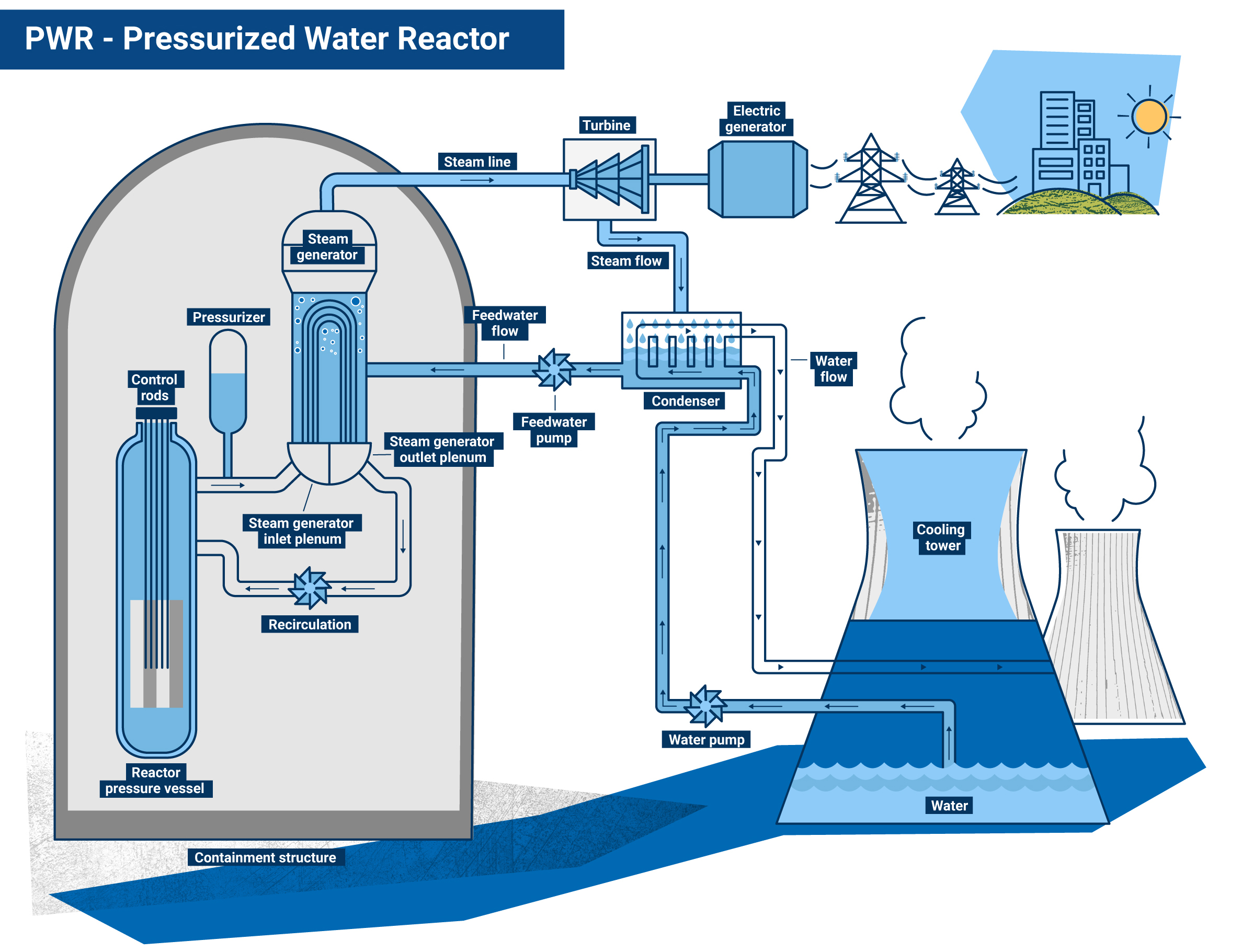
Inside nuclear power plants, nuclear reactors and their equipment contain and control the chain reactions, most commonly fuelled by uranium-235, to produce heat through fission. The heat warms the reactor’s cooling agent, typically water, to produce steam. The steam is then channelled to spin turbines, activating an electric generator to create low-carbon electricity.

Find more details about the different types of nuclear power reactors on this page.

Pressurized water reactors are the most used in the world. (Graphic: A. Vargas/IAEA)

Mining, enrichment and disposal of uranium

Uranium is a metal that can be found in rocks all over the world. Uranium has several naturally occurring isotopes, which are forms of an element differing in mass and physical properties but with the same chemical properties. Uranium has two primordial isotopes: uranium-238 and uranium-235. Uranium-238 makes up the majority of the uranium in the world but cannot produce a fission chain reaction, while uranium-235 can be used to produce energy by fission but constitutes less than 1 per cent of the world’s uranium.

To make natural uranium more likely to undergo fission, it is necessary to increase the amount of uranium-235 in a given sample through a process called uranium enrichment. Once the uranium is enriched, it can be used effectively as nuclear fuel in power plants for three to five years, after which it is still radioactive and has to be disposed of following stringent guidelines to protect people and the environment. Used fuel, also referred to as spent fuel, can also be recycled into other types of fuel for use as new fuel in special nuclear power plants.

What is the Nuclear Fuel Cycle?

The nuclear fuel cycle is an industrial process involving various steps to produce electricity from uranium in nuclear power reactors. The cycle starts with the mining of uranium and ends with the disposal of nuclear waste.

Nuclear waste

The operation of nuclear power plants produces waste with varying levels of radioactivity. These are managed differently depending on their level of radioactivity and purpose. See the animation below to learn more about this topic.

Radioactive Waste Management

Radioactive waste makes up a small portion of all waste. It is the by-product of millions of medical procedures each year, industrial and agricultural applications that use radiation and nuclear reactors that generate about 9% of the world’s electricity. This animation explains how radioactive waste is managed to protect people and the environment from radiation now and in the future.

The next generation of nuclear power plants, also called innovative advanced reactors, will generate much less nuclear waste than today’s reactors. It is expected that they could be under construction by 2030.

Nuclear power and climate change

Nuclear power is a low-carbon source of energy, because unlike coal, oil or gas power plants, nuclear power plants practically do not produce CO2 during their operation. Nuclear power reactors generate about one quarter of the world’s low-carbon electricity and are crucial in meeting climate change goals.

To find out more about nuclear power and the clean energy transition, read this edition of the IAEA Bulletin.

What is the role of the IAEA?

  • The IAEA establishes and promotes international standards and guidance for the safe and secure use of nuclear energy to protect people and the environment.
  • The IAEA supports existing and new nuclear programmes around the world by providing technical support and knowledge management. Through the Milestones Approach, the IAEA provides technical expertise and guidance to countries that want to develop a nuclear power programme as well as to those who are decommissioning theirs.
  • Through its safeguards and verification activities, the IAEA oversees that nuclear material and technologies are not diverted from peaceful use.
  • Review missions and advisory services led by the IAEA provide guidance on the activities necessary during the lifetime of production of nuclear energy: from the mining of uranium to the construction, maintenance and decommissioning of nuclear power plants and the management of nuclear waste.
  • The IAEA administers a reserve of low enriched uranium (LEU) in Kazakhstan, which can be used as a last resort by countries that are in urgent need of LEU for peaceful purposes.

This article was first published on iaea.org on 2 August 2021.

Related resources

Atoms4Climate: IAEA to Showcase Nuclear Science and Technology at COP30

Source: International Atomic Energy Agency (IAEA) –

The International Atomic Energy Agency (IAEA) is attending the 30th United Nations Climate Change Conference (COP30), taking place in Belem, Brazil, from 10 to 21 November.

For the fourth time, the IAEA will be hosting its Atoms4Climate Pavilion in the Blue Zone of the Conference, showcasing how nuclear energy and nuclear science and techniques are crucial for the world’s most pressing challenges. 

Beginning with an Opening Event on 11 November, the IAEA will run a series of events at COP30. 

Following the call for faster adoption of low carbon technology solutions including nuclear energy in the First Global Stocktake at COP28, the IAEA will host an official United Nations Framework Convention on Climate Change (UNFCCC) side event at 16:45 on 18 November on Financing strategies for low carbon energy sources. This event will highlight the critical role of technology and investment in driving action.

During an event on 14 November titled Accelerating SMRs: Financing, Policy and Regulatory Enablers in the Age of AI and Hyperscalers, experts will discuss how innovation, digitalization and strategic investment can unlock the full potential of SMRs – forecasted to play a key role in the IAEA’s projected global nuclear power expansion. 

Throughout the two-week conference, the IAEA will also hold events on the use of nuclear science and technologies to achieve sustainable water management, protect coastal and marine ecosystems, and provide food security.

On 14 November, the IAEA will join the United Nations Food and Agriculture Organization (FAO) and the International Regional Organization for Agricultural Health (OIRSA) to spotlight how the Sterile Insect Technique, a nuclear birth control method for insect pests, is controlling devastating fruit fly infestations in Latin America and the Caribbean. 

An IAEA event on 11 November will look at how COP30 host country Brazil is using nuclear technologies to address environmental challenges, such as pollution, improving water management systems and promoting climate resilience. Other events will look at how nuclear science supports mountainous regions by monitoring glacier retreat, and how it is used to analyse soil and water dynamics and to track Blue Carbon.

Atoms4Climate Pavilion

The Atoms4Climate pavilion will be hosted by the IAEA in the Blue Zone at COP30, presenting nuclear across four thematic areas: energyfood, the ocean and water.

See the IAEA COP30 page for the complete list of IAEA events. 

Nuclear security measures

The IAEA is supporting Brazil in implementing nuclear security measures for COP30 – marking its fifth time assisting a COP host – as part of its support to countries for major public events. As part of the country’s preparations for COP30, projected to have 45 000 people in attendance, the IAEA provided to Brazil training, as well as situational analysis based on information reported to the Incident and Trafficking Database. Training was provided in August to national security experts, including hands-on radiation equipment demonstrations and field exercises.

IAEA media team contacts

For interview requests with IAEA experts and other media-related questions, please contact press@iaea.org.

B-roll footage of nuclear energy for mitigation and nuclear applications for adaption is already available here and will be updated next week with shots from the IAEA pavilion and events at the conference.

For additional requests of B-roll, please contact multimedia.contact-point@iaea.org and copy press@iaea.org.

Photographs from COP30 will be made available on Flickr.

Registration

To attend events in person, you must register for COP30. For media accreditation and all other details concerning the attendance of COP30 events, please refer to the UNFCCCC online registration page. The IAEA cannot assist with accreditation to COP30.

Media kit

The COP30 media kit provides information on the four key areas highlighted at the Atoms4Climate pavilion — energyfood, the ocean and water — along with recent reports and further background information.

The media kit also contains B-roll video footage, videos on the IAEA and climate change and high-resolution images in the IAEA Flickr account. 

This material is free to use under the copyright provisions of the IAEA Terms of Use. If you have further questions, please contact us.

The IAEA’s explainer articlespodcasts and other resources related to climate are available on the IAEA website

Follow the IAEA and #Atoms4Climate on FacebookInstagram, LinkedIn, X and Weibo for updates throughout COP30.

IAEA and AtkinsRéalis Sign Partnership to Support Women in Nuclear Energy

Source: International Atomic Energy Agency (IAEA) –

Jeffrey Donovan, IAEA Department of Nuclear Energy

The IAEA and AtkinsRéalis, a global engineering services and nuclear company and the original equipment manufacturer of CANDU reactor technology deployed worldwide, have agreed to strengthen cooperation in support of women pursuing careers in nuclear science and technology.

Under a new partnership agreement signed today at the World Nuclear Exhibition in Paris, AtkinsRéalis will provide a monetary contribution to the IAEA’s Marie Sklodowska-Curie Fellowship Programme (MSCFP). In addition, the company will support a number of MSCFP fellows in the 2026/2027 academic year, providing bursaries to cover tuition costs of the fellows to pursue graduate studies in nuclear-engineering related fields. 

The MSCFP, established in 2020, aims to increase the participation of women in nuclear science by providing scholarships for master’s programmes in nuclear related subjects and by facilitating internships through the IAEA. More than 760 women from 129 countries have been selected since its launch, with a growing number supported by contributions from governments, organizations and industry partners.

“Our partnership with AtkinsRéalis reflects the IAEA’s commitment to working with innovative and non-traditional partners to shape the future of nuclear energy,” said IAEA Director General Rafael Mariano Grossi. “Together, we are strengthening the foundations of a safe and sustainable nuclear sector — and investing in the people who will lead it, through initiatives such as the IAEA’s Marie Skłodowska-Curie Fellowship Programme.”

“With a global nuclear market for 1,000 reactor new builds, advancements in new technologies like SMRs and nuclear fusion, and rising AI-driven energy demand, the need for highly skilled talent has never been greater,” said Ian L. Edwards, President & CEO, AtkinsRéalis. “As an original equipment manufacturer of nuclear technology, recruiting and retaining top talent, including women in science and engineering, is a top priority. By partnering with the IAEA, we are furthering our legacy of supporting women in engineering around the world.”

AtkinsRéalis brings decades of expertise across the nuclear lifecycle – from design and new build projects to life extension, decommissioning, and waste management. Its participation in the MSCFP reflects the company’s broader commitment to fostering an innovative and inclusive nuclear workforce, while helping to meet the increasing global demand for nuclear energy solutions.

The partnership builds on the IAEA’s growing collaboration with private sector organizations to advance peaceful nuclear technologies and support the next generation of nuclear professionals. With AtkinsRéalis’ support, more women will gain the skills and opportunities to contribute to nuclear innovation, from energy security and climate change mitigation to applications in health and medicine.

Launched in 2020 by IAEA Director General Rafael Mariano Grossi, the Marie Sklodowska-Curie Fellowship Programme (MSCFP) is named after the pioneering physicist and two-time Nobel laureate Marie Sklodowska-Curie. The programme empowers women to pursue degrees of their choosing by easing the financial burden of their studies, and provides the opportunity to pursue internships at the IAEA or with partner organizations like the IAEA Collaborating Centres

Partner With Us

The MSCFP is supported by contributions from IAEA member countries and partners. More information on the programme, including facts and figures, testimonials, donors and programme components can be found here.

The IAEA welcomes both extrabudgetary contributions and in-kind support. Partners can support or cover academic expenses, such as tuition or living costs, as well as internship placements by funding stipends or related expenses. MSCFP host institutions partnering with the IAEA play a key role in the success of the programme, offering hands-on training to women in nuclear through specialized internships. The IAEA continues to partner with more institutions, widening the scope of internships available to fellows in their fields of studies.

Partner with us and see the impact of turning passion into purpose for women in nuclear.

Interested in getting involved or have questions? Send an email.

IAEA Takes Centre-Stage at World Nuclear Exhibition 2025

Source: International Atomic Energy Agency (IAEA) –

Monika Shifotoka, IAEA Office of Public Information and Communication

IAEA Director General Rafael Mariano Grossi spoke at the opening of the World Nuclear Exhibition.

From clean and reliable energy to food security to healthcare, the IAEA is putting nuclear technology and science in the spotlight this week at the World Nuclear Exhibition in Paris.

Taking place on 4 to 6 November, the exhibition attracts professionals from across the civil nuclear sector, covering the entire value chain and nuclear fuel cycle — from mining and fuel fabrication to reactor design, waste management and decommissioning as well as non-electric applications such as water desalination, medicine, agriculture, and space.

At the opening ceremony, Roland Lescure, France’s Minister for the Economy, Finance, Industrial, Energy and Digital Sovereignty, underscored the central role of innovation in shaping the future of nuclear energy. “Innovation is at the heart of what you will see in the next three days — and what we will achieve in the next three decades,” he said. “We must innovate together — in how we finance, govern, build supply chains and public-private partnerships, and in how we attract diverse new talent to shape the future of energy.”

IAEA Director General Rafael Mariano Grossi echoed this call for forward-looking collaboration.

“Two years after COP28’s historic recognition of nuclear’s indispensable role and the pledge to triple global capacity by 2050, we are seeing clear advancements.” 

He added. “From promise to progress, the sector is experiencing a return to realism, as countries expand existing programmes, launch new ones and update regulations to meet future energy needs. The IAEA is proud to take part in this year’s exhibition with its own booth showing how nuclear science supports progress not only in energy but also in health, food, water and more.”

IAEA Pavilion

IAEA engagement at WNE comes as global momentum continues to build behind nuclear energy, amid an international consensus to accelerate its deployment, forged in 2023 at COP28 in Dubai. In September, the IAEA revised up its outlook for the future of nuclear power for the fifth year in a row, projecting that global nuclear power capacity could more than double by 2050. 

The IAEA’s pavilion, which will run throughout the event, showcases how nuclear technologies contribute to achieving climate and development priorities. The pavilion features interactive exhibits on the IAEA’s work to leverage nuclear technology and science to support countries in areas such as energy, food security, healthcare, and environmental monitoring. It also serves as a hub for dialogue and partnerships with industry leaders, innovators, and policymakers.

During the three-day event, the IAEA will sign a partnership agreement with AtkinsRealis — a global engineering firm providing sustainable solutions in energy, infrastructure, and water, and the International Centre based on Research Reactors (ICERR). Under the new partnership, AtkinsRealis will contribute financially to the IAEA’s Marie Sklodowska-Curie Fellowship Programme (MSCFP) and provide bursaries to MSCFP fellows in the 2026/2027 academic year, strengthening support for women pursuing careers in nuclear science and technology. 

Through the ICERR initiative, the two Centres: Belgian Nuclear Research Centre and Centre National de l’Énergie, des Sciences et des Techniques Nucléaires  will sign a collaboration agreement. The IAEA supports member countries to access advanced research reactor facilities worldwide, enhancing education, training, and research and development capacities in nuclear science and technology.

Beyond Electricity

In collaboration with WNE and the French Alternative Energies and Atomic Energy Commission (CEA), the IAEA is participating in the “Beyond Electricity” Expo, held alongside the main exhibition. 

Inaugurated by the IAEA Director General along with partners, the expo will cast a spotlight on how the nuclear applications extend beyond power generation — transforming sectors from food safety to agriculture to healthcare. IAEA’s exhibits demonstrate how nuclear techniques can improve laboratory precision, detect contaminants like lead in fruit juice or mycotoxins in maize, uncover food fraud through bench-top X ray fluorescence and identify food contamination through portable near-infrared devices.

 Visitors can also learn how mutation breeding — which uses radiation to induce beneficial genetic diversity — is accelerating the development of climate-resilient and nutrient rich crops. 

In health, the IAEA is showcasing virtual reality radiotherapy training models that immerse students in realistic treatment settings, helping them build technical skills and improve patient safety. 

These innovative exhibits highlight how nuclear science and technology support practical, people-centred solutions to global challenges.

Dialogue and Partnerships

The IAEA and WNE organizer GIFEN are co-organizing a panel discussion on inclusive and transparent stakeholder engagement in nuclear energy projects. Scheduled for 6 November, the session will feature global nuclear leaders sharing insights from major initiatives and projects. The discussion will explore how strategic engagement – on policy, communities, workforce, and innovation – can drive timely and sustainable nuclear development and deployment.

WNE promotes innovation and supports the participation of new companies and start-ups in the nuclear sector — through programmes such as the Startup Programme and sector-specific activities such as Connect to Nuclear. This year, the event features over 850 exhibitors from 88 countries and is expected to attract over 25 000 participants. 

Follow us on FacebookX (formerly Twitter)LinkedIn, Instagram, and Threads for updates on the exhibition and the IAEA’s work globally. 

Nuclear is Global. Nuclear is Local.

Source: International Atomic Energy Agency (IAEA) –

Globally, nuclear power is crucial for generating an abundant, clean and secure energy supply, with its usage expected to grow in the coming decades. The communities that host nuclear facilities play a key role in this story and are vital to the success of any nuclear power programme.

Update 325 – IAEA Director General Statement on Situation in Ukraine

Source: International Atomic Energy Agency (IAEA) –

An International Atomic Energy Agency (IAEA) team today visited a substation critical to nuclear safety and security in Ukraine and reported damage as a result of recently reported military activities, IAEA Director General Rafael Mariano Grossi said today.  

Following reports of the damage caused, the IAEA promptly dispatched a team to one of the affected substations that had been targeted. The IAEA team conducted a thorough walkdown of the area, gaining immediate, first-hand insights into the damage and assessing its impact on the safety and security of Ukraine’s nuclear power plants (NPPs).  

The team confirmed the damage to the substation’s equipment and determined that there was a negative impact to the reliability of the off-site power supply to Ukrainian NPPs, thus affecting nuclear safety and security. 

“Attacks on Ukraine’s power grid represent an ever-present danger to nuclear safety and security to all nuclear facilities in Ukraine,” Director General Grossi added. 

While restoration activities on the power grid are on-going, one NPP remains without one of its off-site power lines and further repair work is needed. The IAEA will continue to monitor the situation.

IAEA Reviews Latvia’s Nuclear Emergency Preparedness and Response

Source: International Atomic Energy Agency (IAEA) –

An International Atomic Energy Agency (IAEA) team of experts has concluded a ten-day mission to review Latvia’s preparedness and response framework for nuclear and radiological emergencies. The Emergency Preparedness Review (EPREV) Service was carried out at the request of the Government of Latvia and hosted by the Radiation Safety Centre of State Environmental Service of Latvia (RSC SES).

The objective of the mission was to conduct a peer review of Latvia’s arrangements and capabilities for emergency preparedness and response against the IAEA safety standards and to provide advice for further enhancements.

Latvia does not operate any nuclear power plants. The country uses radiation sources in medical, scientific and industrial applications. The country’s research reactor has been permanently closed since 1998 and is currently in the early stage of decommissioning. Latvia operates a disposal and storage site for low and intermediate level radioactive waste, which is located 30 kilometres from the capital Riga. 

In addition to meeting with counterparts from RSC SES in Riga, the EPREV team interviewed a number of other Latvian government organizations, including: the Ministry of Climate and Energy; the Ministry of Agriculture; the State Emergency Medical Service; Pauls Stradins Clinical University Hospital; the State Fire and Rescue Service; the Food and Veterinary Service; the Latvian Environment, Geology and Metereology Centre; and the Institute of Food Safety, Animal Health and Environment.

Genaro Rodrigo Salinas Mariaca, Senior Specialist on Emergency Preparedness and Response at the Federal Authority for Nuclear Regulation in the United Arab Emirates, led the six-person review team, which included experts from Bulgaria, Indonesia, Portugal, Finland and the IAEA. 

“Over the course of our work, we observed a strong commitment across institutions to enhancing nuclear and radiological emergency preparedness and response in Latvia,” Salinas Mariaca said. “The outcomes of this mission highlight both well-established practices and valuable opportunities for further strengthening integration, coordination and resilience.”

The EPREV team identified strengths in Latvia’s EPR framework, including:

  • The continuous proactive approach and strong determination of the RSC SES in leading preparedness and response initiatives for nuclear and radiological emergencies, despite ongoing staff-related constraints;
  • The government’s efforts to establish reliable communication channels to disseminate information and instructions to potentially affected populations, as well as to provide psychological counselling to first responders, emergency workers and the general public in case of emergencies; and
  • Ongoing initiatives to build public trust through effective crisis communication as a way to strengthen the overall national emergency response framework.

The team also made suggestions to further strengthen EPR arrangements, including: 

  • To align national regulations and emergency frameworks with relevant international safety standards;
  • To implement a national coordinating mechanism in all emergency response organizations;
  • To integrate the Crisis Management Centre into the national framework;
  • To conduct hazard assessments in line with relevant international safety standards to support a graded, justified and optimized approach to nuclear and radiological emergency arrangements;
  • To adopt reference levels, generic criteria and operational intervention levels in line with relevant international safety standards, defining guidance values for emergency workers and helpers, and including provisions to register and integrate non-designated emergency workers and helpers into emergency response arrangements; and
  • To establish arrangements for environmental and food monitoring during emergencies, setting clear criteria for the termination of emergencies and transition to recovery, and ensuring post-emergency analysis to support continuous improvement. 

The team emphasized the importance of ensuring that RSC SES and all key organizations have sufficient qualified personnel to effectively carry out their emergency responsibilities. 

“Latvia welcomes the completion of the IAEA EPREV mission, and I thank the international team for their professionalism, expertise and constructive engagement,” said Latvia’s Minister of Climate and Energy, Kaspars Melnis. “This review has enabled us to benchmark our systems against international best practices, identify areas of strength and pinpoint opportunities for improvement. We are committed to translating the mission’s recommendations into concrete measures to further enhance our preparedness and response capabilities, ensure public confidence, and remain aligned with international safety standards. Latvia values its partnership with the IAEA and looks forward to deepening cooperation in the years ahead.” 

About EPREV Missions

EPREV missions are one of the peer reviews offered by the IAEA to strengthen nuclear safety in Member States. EPREV missions focus on the arrangements and capabilities to prepare for and respond to nuclear and radiological emergencies. EPREV missions are based on the IAEA Safety Standards in preparedness and response for a nuclear or radiological emergency.

IAEA Safety Standards

The IAEA Safety Standards provide a robust framework of fundamental principles, requirements and guidance to ensure nuclear safety. They reflect an international consensus and serve as a global reference for protecting people and the environment from the harmful effects of ionizing radiation.

The IAEA: Rising to Today’s Challenges and Maximising the Enormous Benefits of Nuclear Science and Technology

Source: International Atomic Energy Agency (IAEA) –

(As prepared for delivery)

Madam President, excellencies, distinguished delegates,

I would like to start by congratulating Her Excellency Ms. Annalena Baerbock on her assumption of the office of the President of the 80th session of the United Nations General Assembly. It is an honour to address the General Assembly, to present the report of the International Atomic Energy Agency (IAEA) for 2024, and to update you on the Agency’s work. I would like to commend and thank His Excellency Mr Ian Biggs of Australia, chairperson of the IAEA’s Board of Governors, for his efforts in finalizing the draft resolution on the report of the Agency.

This General Assembly is happening at a crucial moment. Conflict, the erosion of global norms, and the gap between poor and rich are pulling at the fabric of our coexistence.

At times like these, International Organizations have a decision to make: Either continue along the path as if nothing has changed or recognise the challenges we face and choose paths that meet them.

At the IAEA we have our eyes wide open to today’s realities, and I will endeavour to describe the paths we are taking to support international peace and security.

We work at the intersection of nuclear non-proliferation, energy security and development. Our unique mandate ranges from reducing the risk of more countries having nuclear weapons to using nuclear science and technology to help support our 180 Member States in meeting their economic, environmental and social goals.

In essence, we help the world answer a fundamental question, that for more than 80 years has shaped its existence: How do we use the atom? Do we use it to overcome disease, hunger, pollution and energy insecurity, or do we use it as a weapon capable of ending life on earth as we know it?

The IAEA widens the access to nuclear science, technology and know-how. That includes, radiotherapy machines that diagnose cancer; nuclear power plants that provide low-carbon energy; and nuclear science applications that improve agriculture, track pollution, and provide the facts on which sound policy is made.

The IAEA supports nuclear safety and security so that nuclear science and technology benefit people and the environment and do not harm them, even at times of war.

As Director General I travel across the world fulfilling the IAEA’s mandate. At times of diplomatic disagreements, I have used my good offices to meet with leaders on opposing sides. The IAEA’s presence and its scientific know-how has brought clarity in difficult and unprecedented circumstances, from elucidating the situation at nuclear power plants at the front lines of the war in Ukraine to providing trusted analysis of water samples off the coast of Fukushima.

Responding to unprecedented challenges and opportunities has meant applying our mandate and all the assets of the IAEA in new ways amid tight budgets being made even tighter by inflation.

Madam President,

Let me start with our role as the world’s nuclear watchdog and then describe in more detail our work supporting social and economic development.

When the IAEA confirms the peaceful use of a State’s nuclear material, confidence over nuclear activities is established. History shows that when confidence disappears, international peace and security are at risk. This was the case in the DPRK, in Iraq, in Syria and most recently in Iran.

Last year, the Agency conducted more than 3 000 in-field verification activities in more than 1 300 facilities, with more than 240 000 significant quantities of nuclear material under its safeguards. As a result, we were able to draw safeguards conclusions for 175 States for which safeguards were applied. Where there have been unanswered questions, we have been firm, fair and steadfast in our efforts of engagement.

In June, after the attacks on Iranian nuclear facilities, we had to withdraw our inspectors. In September in Cairo, the Foreign Minister of the Islamic Republic of Iran Dr Abbas Araghchi and I signed, under the auspices of Egyptian President Abdel Fattah El-Sisi and Foreign Minister Badr Abdelatty, an agreement that provides a clear understanding of the procedures for inspection, notifications, and implementation.

It is now time to implement the agreement. I am confident that a return of IAEA inspectors and the resumption of safeguards implementation in Iran would serve as a sign that agreements and understandings are possible. Nothing can replace dialogue in the pursuit of durable, lasting solutions to international challenges.

Both in international organizations and in diplomacy it is as important to grasp opportunities, as it is to rise to challenges. We must pursue every chance to bring States back into the fold of the international community. The IAEA has been doing this in Syria. I have met with President Ahmed Al-Sharaa as we look to make transparent and close a chapter of Syria’s past nuclear activities and enable the Syrian people to benefit from the peaceful applications of nuclear science and technology.

The global nuclear non-proliferation regime is under significant strain and we need to protect it. This is a message I shared with the Security Council a few months ago.

The Democratic People’s Republic of Korea’s nuclear weapons programme continues in contravention of several UN Security Council resolutions.

But even within some countries in good standing with their obligations under the NPT, there are now open discussions about whether or not to acquire nuclear weapons.

We do not want a world with dozens of nuclear-armed States. In times like these, your support of the non-proliferation regime, the NPT and the IAEA, is even more crucial to international peace and security.

In April next year, here at UN headquarters, the IAEA will again report to the NPT Review Conference on its work making operational this crucial treaty.

Madam President,

The war in Ukraine – the first to threaten a major nuclear power programme – continues to threaten nuclear safety and security. Frequent power outages caused by the fighting, and military activities near the NPPs, heighten the risk of a nuclear accident at Europe’s biggest Nuclear Power Plant.

Despite considerable challenges, including, more than once, direct attacks on our teams, the IAEA maintains an uninterrupted presence at all the plants, rotating staff in and out of the area. They are providing indispensable support, actively assisting operators in looking after the Seven Pillars of nuclear safety and security and the Five Principles for protecting the Zaporizhzhya NPP, which we established at the UN Security Council in 2023, while keeping the international community informed through regular updates.

In spite of the difficulties, I have kept an open dialogue with both sides, meeting with President Vladimir Putin of the Russian Federation and President of Ukraine, Volodymyr Zelenskyy, to keep this terrible war from causing even more misery through a nuclear accident with radiological consequences. Meanwhile, we continue to deliver nuclear safety and security-related equipment, as well as medical equipment to Ukraine.

In another area of importance for nuclear safety, I have said that the IAEA will be there before, during and after the discharge into the sea of the water that once cooled the Fukushima Daiichi Nuclear Power Station’s reactors damaged in the 2011 accident and has been treated and stored.

Under the IAEA, independent monitoring, sampling, and analysis of the water has confirmed tritium levels that are well below regulatory and operational limits. In response to regional concerns, we introduced additional trust-building measures that expanded international involvement in the process.

Madam President,

For decades, scientists have been raising the alarm over the impact of harmful greenhouse gases on our planet and its people. But for many years, many people – including policy makers – looked away from a very important, proven low-carbon energy sources that is safe and scalable.

But the tide has now turned, and we have seen a return to realism when it comes to nuclear energy. Facts and the need for energy security have firmly overtaken misplaced ideology and the world has agreed that global climate goals cannot be met without it. Countries with nuclear programmes are expanding them, and about 30 “newcomer countries” are building or planning their first nuclear power plants.
In 2024, 417 operating nuclear power reactors in 31 countries produced about 10% of the world’s electricity and a quarter of its low-carbon electricity. More than 60 new reactors were under construction and more planned.

Projections were again raised, with the IAEA expecting nuclear energy capacity to increase as much as two and a half times by 2050. The momentum continues, but there is work to do.

Three keys are required to unlock global nuclear capacity at that scale: One, newcomer countries require support; two, regulation must adapt; and three, financing needs to be made possible. In all three areas the IAEA made strong progress. The IAEA’s Milestones Approach remains the gold standard when it comes to developing a new nuclear programme, with our Integrated Nuclear Infrastructure Review missions supporting newcomer countries.

Many countries and industries are interested in using Small Modular Reactors (SMRs). Developing countries see them as more affordable and appropriate ways to power their economic development. Technology companies want them to run the energy hungry data centres fuelling the AI revolution. But first SMRs will need to be deployed, and that will require regulators to update their approaches without compromising safety. The IAEA’s Nuclear Harmonization and Standardization Initiative (NHSI) advanced its work in bringing together regulators to harmonize their approaches to regulation, and industry to standardize their approach to design. We have organized workshops and SMR schools in Asia, Africa and Latin America, and our SMR platform is a growing resource covering all aspects of the technology.

We continued to support non-power applications of nuclear energy, from hydrogen production to industrial heat, and seawater desalination to marine propulsion.

Developing countries must not be left behind, and the IAEA has been working with many in support of their wishes to introduce nuclear energy. We have also been working closely with the World Bank and other international financial organizations to make sure they have financing options. I am pleased to note that the World Bank this year lifted its ban on supporting new nuclear energy projects, marking a milestone and important step in getting nuclear power to countries that want and need it.

Madam President,

The range of lifesaving and life-affirming uses of nuclear science and technology is extraordinary. A very important part of the IAEA’s mandate is to widen their global reach. Our work in this area is deeply rooted in our mission of “Atoms for Peace and Development”. It is why many of our Member States join the IAEA and it is foundational to creating lasting peace and security.

Cancer is an acute crisis holding back many developing countries. It is a crisis for the those suffering from the disease and for the overwhelmed health systems unable to offer adequate treatment, including through the use of radiotherapy.

I have been determined that the IAEA, in close collaboration with its Member States and other international and financial organizations, be the catalyst for doing more. We have been doing this through the Rays of Hope initiative launched three years ago. Through Rays of Hope, concrete actions have been taken in 40 countries: hospitals have been built, radiotherapy machines procured, physicists trained, and lives saved. We have more than doubled the number of Rays of Hope Anchor Centres that serve as regional hubs of excellence and training across the world.

But more still needs to be done – we will continue, energized by the success of the past years.

Nuclear applications have also been key in fighting communicable diseases. I know that not one of us wants to witness another pandemic. But it is clear that COVID is not the last major zoonotic virus that we will have to contend with. The imperative is to catch their outbreak early. It is why, in the middle of COVID-19, we launched Zoonotic Disease Integrated Action, or ZODIAC. It has improved the preparedness of countries around the world. The ZODIAC network now is truly global, with 129 national laboratories already involved. More and more potentially devastating pathogens are being characterized, and the iVetNet platform now tracks data from more than 2 400 institutions. We are nipping the threat of the next pandemic in the bud.

Madam President,

In a world of abundance, 700 million people should not have to go to bed hungry.

Atoms4Food is a joint initiative between the IAEA and the Food and Agriculture Organization of the United Nations (FAO) that provides tailor-made solutions to boost food security, support food safety and nutrition, and reduce agriculture’s strain on the environment. It is quite incredible what nuclear science and its applications can do.

Through Atoms4Food, we are supporting the use of irradiation to create hardier varieties of crops like bananas, cassava, rice and sorghum.
Through isotope hydrology, we are helping communities better manage their aquifers and water supplies.

Harmful insect populations are being shrunk through the Sterile Insect Technique, reducing pests like the fruit fly and New World Screwworm that decimate harvests and cause diseases in livestock.

In marine environments, we are fighting a different sort of pest. Microplastics are everywhere. They blight our common home and are present in the farthest reaches of our ocean. To create policies that tackle microplastic pollution, we must first better understand it. We need to know how it travels through our ecosystems and what impact it is having. The IAEA’s NUTEC Plastics initiative has two distinct approaches to dealing with plastic pollution. One supports 100 Member States wanting to use technology like infra-red spectroscopy to monitor and characterize microplastic marine pollution. The second supports more than 50 Member States looking to radiation-assisted technology to upcycle plastic waste into valuable products like construction material. Together, these approaches inform policies and create pathways towards a circular economy in which less plastic ends up in the ocean in the first place.

Madam President,

I do not deny that the world is going through serious political upheavals and that there are many problems in need of solutions.

But the future has not been dimed. We must grasp opportunities, point out what is right with this world, and empower nations and people to be part of shaping their future. Optimism takes courage and in times like these we must find ways to bring people with us in hope.
In the history of humankind, we have never before had the chance to know and do so much.

Artificial Intelligence and Machine Learning are giving each of us the chance to create the future we want.

Nuclear energy is back, and fusion energy is coming on in leaps and bounds. Private capital and public programmes are accelerating progress towards demonstration plants. The IAEA is playing its own part, through its World Fusion Energy Group, which is advancing work on regulatory frameworks, commercialization pathways and public engagement. We are bringing together the smartest people in AI with the smartest people in nuclear energy to discuss how nuclear power can fuel AI and how AI can improve the nuclear energy sector.

Madam President,

Every challenge is an opportunity. Peace is not passive – it is a dynamic, hopeful striving that requires all of us, women and men working together.

One the first things I did when I was elected Director General, was to announce the target of having equal numbers of men and women in the IAEA’s professional and higher jobs categories. It was a bold call at the time. Back then, women made up less than 30 percent of those roles, the IAEA was behind other members of the UN family, and the nuclear sector was far from embracing its full potential pool of talent. I am proud to be able to tell you that we reached parity ahead of our 2025 target.

Meanwhile, our dedicated programmes to widen the workforce of the global nuclear sector continue, including the Marie Sklodowska-Curie Fellowship Programme and the Lise Meitner Programme.

The IAEA has the steadfast support of its Member States. This is a testament to their belief in our mandate and in the way we are fulfilling it.
We have shown that it is possible to make a big positive impact by using the resources entrusted to us wisely and efficiently.

We have been working harder and smarter amid a budget that has witnessed zero nominal growth over several years of strong price inflation.

Madam President, ladies and gentlemen,

The IAEA is indispensable, and it will continue to be in the years to come. Thank you for the support you have given me and the Agency. Together, we will continue to rise to global challenges, stay positive, grasp opportunities, and serve humanity actively and with a commitment that befits our noble cause. The IAEA truly and really delivers, for all.

Thank you.

Update 324 – IAEA Director General Statement on Situation in Ukraine

Source: International Atomic Energy Agency (IAEA) –

Efforts to facilitate the repair of the 330 kV Ferosplavna-1 power line at Ukraine’s Zaporizhzhya Nuclear Power Plant (ZNPP) are ongoing, following the discovery last week of additional damage to the line during the successful reconnection of the plant to Ukraine’s power grid, IAEA Director General Rafael Mariano Grossi said today.

During repair work to restore off-site power to the plant – ending a full month without external electricity – the IAEA confirmed the detection of additional damage to the back-up Ferosplavna-1 line located about 1.8 kilometres from the Zaporizhzhya Thermal Power Plant’s switchyard. 

Negotiation efforts are now focused on the full restoration of the Ferosplavna-1 power line, one of ten lines the ZNPP had access to prior to the conflict. This line, along with the recently restored Dniprovska line, was one of the two remaining lines used by the plant. Ferosplavna-1 was lost on 7 May, while the Dniprovska line was disconnected late last month. Both sides have attributed the damage to ongoing military activity in the region.

“We continue to work intensively to support the conditions needed for this additional repair work to begin. Restoring this power line is essential to improving the fragile nuclear safety and security situation at the site,” said IAEA Director General Rafael Mariano Grossi. 

Although the plant’s six reactors have been shut down for more than three years and are not generating electricity, they still require a stable power supply to operate essential safety systems, including cooling pumps and other nuclear safety and security equipment. Over the past month, these systems were powered by emergency diesel generators, underscoring the plant’s continued vulnerability amid the conflict.

Separately, the IAEA has been informed of military activity in Ukraine early this morning that has led to damage to substations critical to nuclear safety and security in Ukraine. Following this, IAEA teams at both South Ukraine Nuclear Power Plant (SUNPP) and Khmelnitsky Nuclear Power Plant (KhNPP) have reported that each of the plants have lost access to one of their off-site power lines. Furthermore, the IAEA team at the Rivne Nuclear Power Plant (RNPP) have reported that the plant has reduced the power of two of its four units at the request of the grid operator. The team at KhNPP also had to shelter at their hotel for several hours this morning. 

“The dangers to nuclear safety continue to be very real and ever-present,” said Director General Grossi. “I once again call for maximum military restraint in the vicinity of nuclear facilities and full respect of the seven indispensable pillars for nuclear safety and security.” 

The IAEA continues to implement its comprehensive programme of assistance to Ukraine in nuclear safety and security. In October, the Agency delivered a package of support under the IAEA Support and Assistance Mission to the Kherson Oblast (ISAMKO), established in response to the catastrophic flooding caused by the destruction of the Kakhovka dam in June 2023. As part of this package, Ukrainian Meteorological Institute received a high precision isotopic water analyzer to support Ukraine’s environmental and hydrological monitoring efforts. Staff of the Institute also received training in Vienna on how to build essential skills for practical application and operation of the received analyser in support of conducting accurate isotopic analyses of water samples. The assistance was funded with support from Japan.

ISAMKO is designed to strengthen Ukraine’s capacity to address the environmental, health, and infrastructural impacts of the disaster. The programme includes the procurement of equipment and supplies, technical advice, and capacity building in key areas such as civil structure integrity, food and water safety, public and animal health, and agricultural recovery. 

Previous deliveries under ISAMKO include diagnostic equipment for the Kherson Regional Clinical Hospitalradiation monitoring equipment for the South Ukrainian Geological Company and the regional state laboratory in Mykolaiv province received a generator and a real-time PCR cycler (Polymerase Chain Reaction, a nuclear-derived technique) for fast and accurate analysis to help it fight the spread of disease as a result of the flooding. 

“The IAEA is helping Ukraine not only uphold nuclear safety and security, but also respond to the environmental and health impacts of the Kakhovka dam flooding,” said Director General Grossi. “Even amid war, building national capacity with nuclear-derived tools is essential to protect people and ecosystems.”

The training delivered for the staff of the Ukrainian Meteorological Institute is the first in a series of trainings already planned for different ISAMKO beneficiaries, with three additional training events planned in the coming months. 

Further to this assistance work under ISAMKO, the IAEA continued its deliveries related to nuclear safety and security and medical assistance, bringing the total to 169 shipments of essential equipment and supplies to Ukraine since the start of the armed conflict.

As part of these deliveries, the SUNPP received personal protective equipment and medical units at the Chornobyl Nuclear Power Plant (ChNPP), and RNPP and SUNPP received various medical supplies. The Slavutych City Hospital, the National Research Center for Radiation Medicine (NRCRM), Varash Hospital, and South Ukraine City Hospital, providing medical care for the NPP personnel, received a range of medical equipment and supplies.

All these deliveries were made possible through funding from Italy, Japan, and Sweden. With these deliveries, priority equipment and supplies worth over €20 million has reached Ukraine since the start of the conflict.